I Tried 4 Table Fixes. Only One Held a Week.
I tried shims, pads, leg trimming, and self-leveling feet on a wobbly dining table. Four attempts, four lessons — the fix was simpler than any of them.
TL;DR
A wobbly table usually means the floor is uneven, not the legs. I tried four fixes: a cardboard shim that compressed in two days, a rubber pad that made the table slide, trimming a leg 1/4-inch too short (which made things worse), and self-leveling feet that spun loose under normal use. The fix that held: adhesive felt pads stacked on the short leg, cut to fit after measuring the gap with a folded business card. Three dollars and the table has been stable for over two months.
Our dining table came from an estate sale — solid oak, heavy as a car door, eight feet long. It sat in the previous owner’s dining room for thirty years without a wobble. I brought it home, set it in the spot where our old table lived, and the front right leg hovered about an eighth of an inch above the floor. The whole table rocked when you leaned on that corner. Not violently, but enough that a glass of water would send ripples across the surface every time someone set down an elbow.
I spent a week trying to fix it. I tried four approaches. Three failed within days. The fourth cost nothing I did not already have and has stayed solid for two months.
This is the sequence of what I tried and what each failure taught me.
Fix 01 — The Cardboard Shim
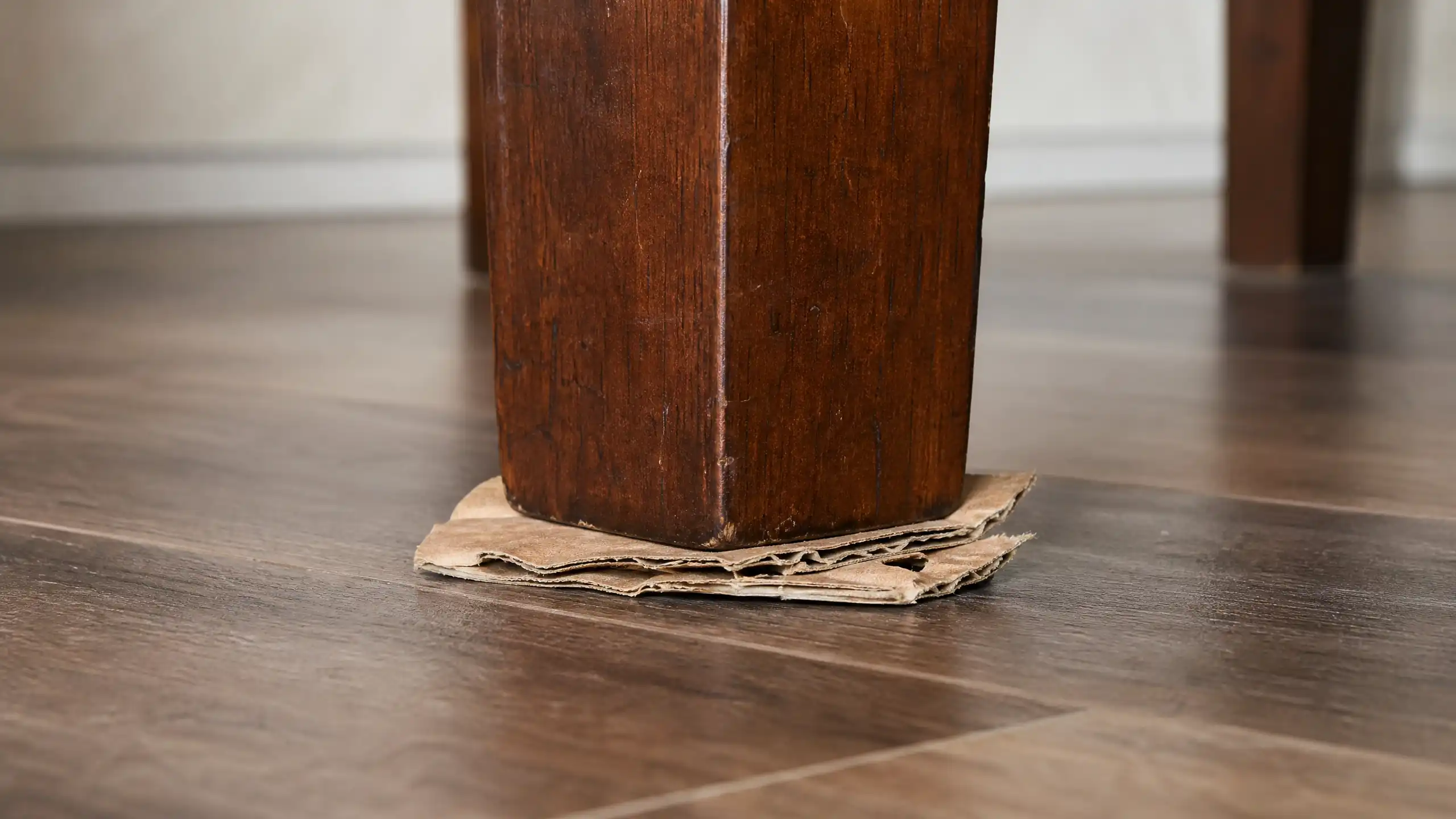
Day one. I lifted the low corner, wedged a folded piece of cardboard under the leg, and set the table back down. The wobble was gone. I felt like a genius for about forty-eight hours.
Cardboard compresses. That is its job in packaging and its fatal flaw in furniture. By day two the cardboard had flattened under the weight of the table — roughly a hundred and fifty pounds of solid oak plus whatever was on it — and the wobble was back within a sixteenth of an inch of where it started. I peeled the cardboard out and found it had been squeezed to half its original thickness.
Lesson one: nothing that compresses under load will fix a table. The shim needs to take the full weight and hold its shape.
Fix 02 — The Rubber Furniture Pad
Day two. I bought a pack of clear rubber furniture pads from the hardware store, the kind shaped like a small disk with a sticky back. I stuck one to the bottom of the low leg and set the table down.
The wobble stopped. But now the table slid. Every time someone pushed their chair back, the table would drift on the rubber pad instead of staying put. Rubber grips the floor initially, then the weight of the top creates a low-friction interface that lets the leg skate. After three days the table had migrated about an inch out of alignment with the light fixture above it.
I pulled the rubber pad off. The adhesive left a residue ring on the leg that took mineral spirits to clean.
Lesson two: a fix that introduces a new problem is not a fix. Rubber pads work on chair legs that need occasional repositioning. They do not work on a table that needs to stay put.
Fix 03 — Trimming the Leg
Day four. This was the stupid one. I convinced myself the problem was the leg, not the floor. I measured the gap with a tape measure — roughly 1/4 inch — marked the bottom of the short leg, and cut it with a handsaw.
The problem: I misjudged the angle. The floor does not slope in a straight line; it dips and rises across the room. The quarter-inch gap I measured on that corner was only true with the table in that exact position. After I cut the leg and set the table back down, the other three corners carried the weight unevenly and the table rocked front-to-back on two alternating legs. I had turned a three-point wobble into a four-point teeter. The cut was irreversible.
I spent an hour trying to fix the new wobble by folding paper shims under the opposite corners. Nothing worked cleanly. I had made a stable table worse.
Lesson three: do not cut anything until you have ruled out every non-permanent option. Table legs are not adjustable once the wood is gone.
Fix 04 — The Self-Leveling Feet That Did Not Hold
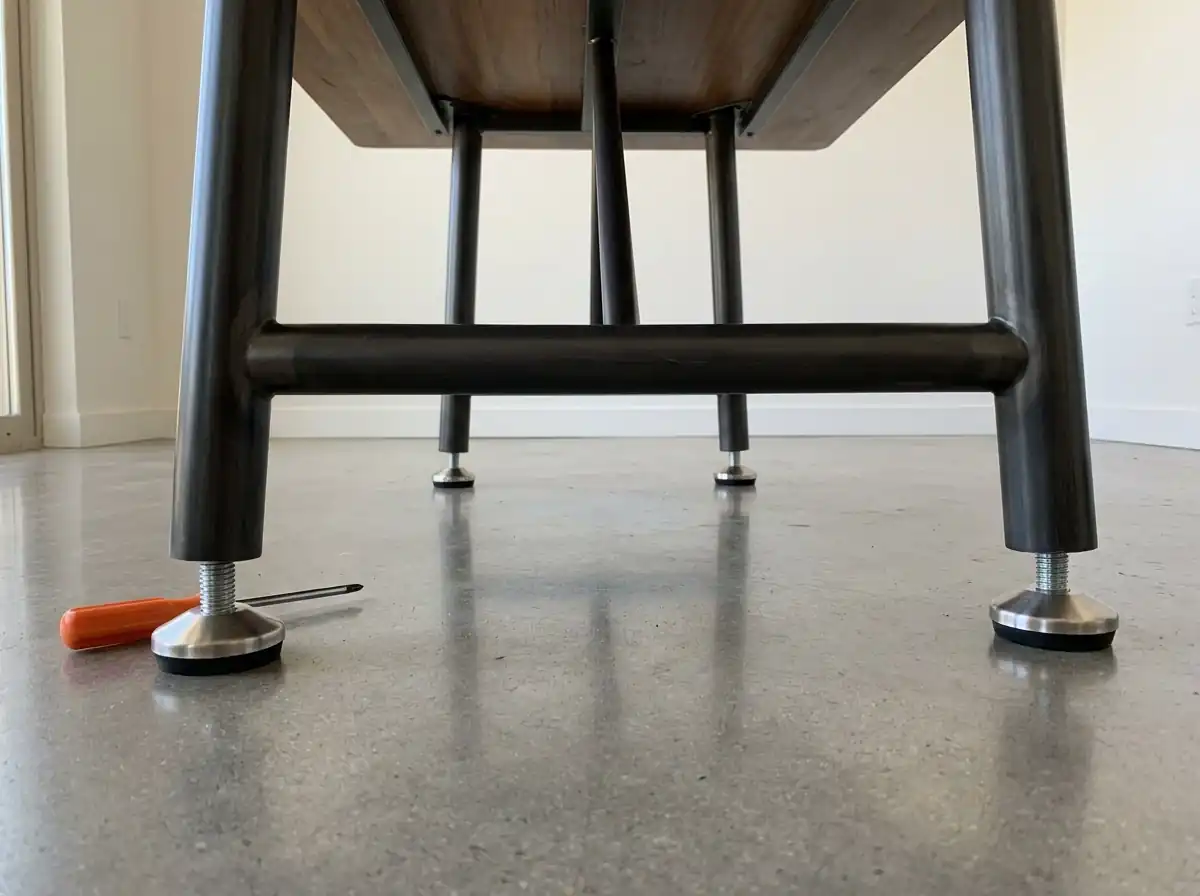
Day five. Frustrated, I ordered a set of self-leveling furniture feet — plastic threaded disks that screw into the bottom of each leg and adjust individually with a wrench. The concept is good: dial each foot to the exact height needed and the table sits level regardless of the floor.
The execution was not. The plastic threads grabbed well enough when I installed them, but within three days two of the four feet had spun loose under normal use. The vibration of footsteps, the shifting weight of people leaning on the table, the slight expansion and contraction of the wood with humidity changes — all of it conspired to unscrew the feet a fraction of a turn at a time. By day six the wobble was back, and I was retightening the same two feet every evening.
I tightened them with a wrench past where I could reach by hand. That stripped one of the plastic threads. At that point the foot was useless and I had a table leg with a mangled insert that no new foot would seat into.
Lesson four: plastic adjustment threads on a heavy table are a maintenance trap. The foot that stripped cost me time, money, and the option to go back to bare wood.
The Fix That Held: Stacked Felt Pads
Day seven. Two months later the same fix is still holding. Here is what actually worked.
I folded a business card into a strip about an inch wide and slid it under the low leg until it touched the floor. That gave me the exact gap — slightly more than 1/8 inch, less than 3/16 inch. Then I stacked three adhesive felt furniture pads on top of each other, trimmed the stack to the shape of the leg bottom with scissors, and pressed them onto the foot.
The felt compresses about ten percent initially, then stops. The adhesive holds the stack together and to the leg. The bottom layer contacts the floor with a smooth, non-slip surface that does not slide like rubber and does not compress like cardboard.
I checked with a level. The table sits dead flat. Two months of daily use — breakfast, dinner, a kid doing homework at one end — and the felt stack has not shifted or compressed noticeably. I do not check it anymore because there is nothing to check.
If I need to move the table to a different room with a different floor slope, I peel the felt stack off, replace it with a new one cut to the new gap, and the whole process takes five minutes. No tools, no permanent change to the table, no damage to the floor.
If felt pads do not hold because the floor has a steep slope — more than a 1/4-inch drop over the width of the table — you may need a wedged shim cut from a hardwood scrap at a five-degree angle. But test the felt first. Most table wobbles are smaller than they feel.
What I Learned
The cheap fix won because it did not try to overpower the floor. Felt accepts that the surface is uneven and adapts to it without resisting. Cardboard tries and fails because it gives up under load. Rubber resists and creates a new problem. Cutting fights the floor permanently and loses when the floor turns out not to be the enemy.
If your table wobbles, start with a business card under the short leg. That gives you the gap. Then buy a pack of adhesive felt pads. Stack them until the level says flat. That is the whole procedure. It is not dramatic. It will not sell a specialty tool. But it is the only fix out of four that worked longer than a weekend.
The Upgrade I Would Make Next Time
I would skip the hardware store specialty shelf entirely. The felt pads were in the same aisle as the rubber pads I bought on day two, and they cost about the same. The difference was not the product category; it was choosing the material that compresses to a point and stops instead of one that keeps compressing forever.
I would also check the floor first. A carpenter’s level on the floor itself would have told me in ten seconds that the problem was the room, not the table. I wasted six days fighting the wrong variable.
Tools I Used
- Folded business card (gap measurement)
- Scissors (cutting felt pads to shape)
- Carpenter’s level (verifying the tabletop sits flat)
- Adhesive felt furniture pads (the fix)
Everything except the level was already in the house. The felt pads cost three dollars for a pack at the hardware store. I used three pads from the pack and gave the rest to my neighbor.
Key Takeaways
- Test the wobble on all four corners before cutting or shimming anything — the problem is almost always the floor.
- A business card folded to the gap thickness is the best measuring tool for finding how much lift you need.
- Stacked adhesive felt pads cost a few dollars, hold reliably, and do not damage the floor like trim cuts do.
- Never trim a table leg on a first attempt at leveling. You cannot undo a cut.
Frequently Asked Questions
What causes a table to wobble?
Can I just cut one leg shorter to fix a wobble?
How many felt pad layers do I need?
Do self-leveling furniture feet work?

Malik Areeb Ahmed is a contributor at Aesthetic Vibes, covering home improvement and DIY projects.