Garden Privacy Screens: 8 Options Compared (Cost/Speed)
A practical comparison of hedges, fences, trellises, and portable screens for garden privacy - costs, speed, upkeep, and which one fits your yard.
TL;DR
For privacy in under a season, use a solid fence panel, a portable louvered screen, or a bamboo screening roll attached to an existing rail. For privacy that improves over years and needs no permit in most areas, plant a fast-growing hedge like Thuja Green Giant or clumping bamboo, spaced 5-6 feet apart. Combine a low structure with a climbing vine if you want a living look without a decade-long wait.
Most people start looking for a garden privacy screen for one of three reasons: a new neighbor’s second-story window now looks straight into the yard, a deck or hot tub feels too exposed to use comfortably, or a busy street or path runs along one side of the property. The right fix depends less on taste and more on how fast you need the privacy, how much you’re willing to spend, and whether you’re allowed to build something permanent. Below are eight approaches people actually use, in order of how quickly they deliver privacy, with the real trade-offs for each.
1. Solid fence panels
A solid wood, vinyl, or composite fence panel is still the fastest permanent option. Installed correctly, it blocks the view completely from the day it goes up, needs no watering or pruning, and lasts 15-20 years for a well-built wood fence or considerably longer for vinyl or composite.
The catch is cost and permitting. Expect to pay roughly $25-$45 per linear foot installed for a 6-foot wood privacy fence, more for composite. In many U.S. municipalities a 6-foot backyard fence doesn’t require a permit, while front-yard fences are usually capped at 3 to 4 feet to preserve sightlines for drivers - but this varies by city, and HOAs often add their own material and color restrictions on top of the municipal limit. Check with your local building department before ordering materials, not after.
Best for: anyone who wants a one-time project and a fixed cost, and doesn’t mind waiting on permit approval if one’s required.
2. Lattice panels
Lattice sits a step down from a solid fence in both cost and total privacy. It blocks sightlines partially rather than completely, which some people prefer - full sightline blocking can feel like living behind a wall, while lattice keeps some light and airflow moving through. It’s also usually shorter and lighter than a solid fence, so it can often go on top of an existing shorter fence to add another 1-2 feet of height without triggering the same permit threshold as building a taller solid fence from scratch.
Pair it with a climbing vine (see method 4) and the lattice becomes a green wall within a season or two, which solves the “too much gap” complaint on its own.
Best for: softening a boundary without a fully solid wall, or adding height cheaply to an existing fence.
3. Fast-growing hedges
A living hedge is the only option on this list that gets better looking every year instead of aging. The trade-off is time: even a fast grower needs a full growing season or two before it reads as a real screen.
Growth rate is what separates a hedge that works from one that disappoints. Thuja Green Giant and Leyland Cypress are the two most commonly planted fast growers, each adding roughly 3-5 feet of height per year in good conditions, and both are typically spaced 5-6 feet apart on center to form a continuous wall rather than a row of separate shrubs. Clumping bamboo (look specifically for Bambusa or Fargesia on the label) is worth considering too - it grows fast and gives a dense, exotic screen, and unlike running bamboo it stays in a contained clump instead of spreading through underground rhizomes into the rest of the yard or a neighbor’s.
Budget tip: bare-root hedging whips (small, unpotted plants sold dormant in winter) cost a fraction of container-grown plants of the same variety and establish just as well if planted while still dormant.
Best for: anyone planning more than a year ahead who wants privacy that improves with time and adds real property value.
4. Trellis with climbing vines
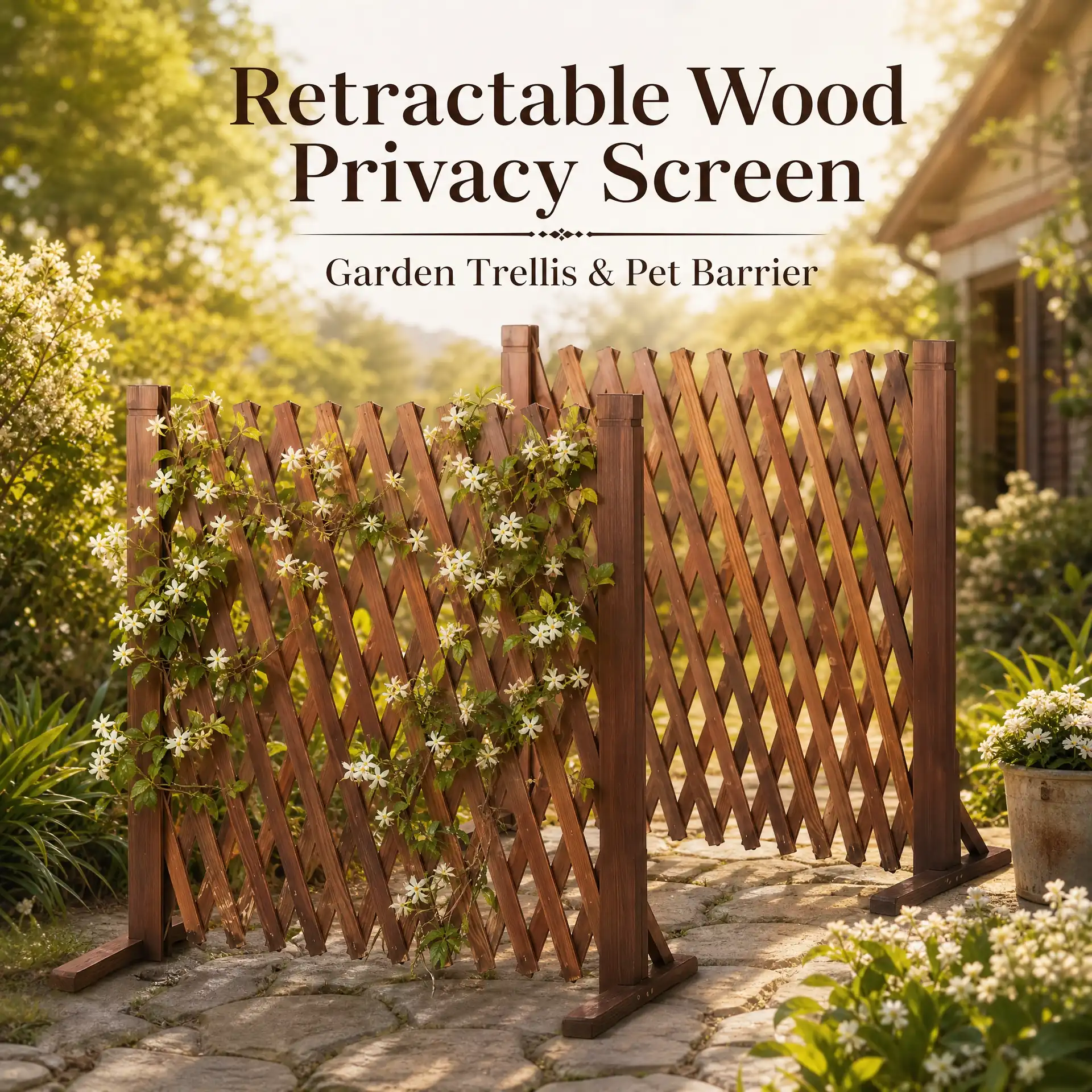
A trellis solves the biggest weakness of a bare hedge - the wait - by giving a vine something to climb immediately, so you get vertical coverage faster than a shrub alone would provide. Fast climbers worth considering: clematis and climbing hydrangea for cooler climates, star jasmine or Boston ivy where winters are milder. Evergreen options like star jasmine hold their leaves year-round; deciduous vines like clematis will drop leaves in winter, which matters if the screen needs to work in every season.
A trellis against an existing fence, wall, or even a run of cattle panel is usually the cheapest structural option on this list, since the vine does most of the visual work once established.
Best for: adding height and softness to an existing boundary that’s otherwise too low or too plain.
5. Bamboo or reed screening rolls
These are rolled panels of split bamboo, reed, or willow that attach directly to an existing chain-link fence, railing, or plain wood fence with zip ties or wire. Installation takes an afternoon, materials typically run $3-$8 per square foot, and the finished look is a natural, textured screen rather than bare metal or wood.
The downside is lifespan - most rolled screening lasts 3-7 years outdoors before it needs replacing, shorter in wet or high-UV climates, so factor in that it’s a recurring cost rather than a one-time purchase.
Best for: covering an ugly existing fence cheaply, especially in a rental where you can’t replace the fence itself.
6. Freestanding or portable privacy screens
Louvered panel screens, folding trellis screens, and planter-box screens (a large planter with a built-in trellis or slatted panel on top) all share one advantage: nothing gets attached to the property. They can be moved, angled toward the exact sightline that needs blocking, and taken along when you move.
They’re also the most flexible option for a deck or patio, where you often need to block one specific angle - a neighbor’s upstairs window, for instance - rather than screen an entire property line. A single well-placed panel can solve that without any construction at all.
Best for: renters, patios and decks, and anyone who needs to block one specific sightline rather than an entire boundary.
7. Outdoor curtains or fabric panels
Heavy outdoor fabric, hung from a rod between two posts, a pergola frame, or even two sturdy shepherd’s hooks, is the most adjustable option on this list. Curtains can be tied back for sun and airflow, closed for privacy or wind-blocking, and swapped seasonally without any tools.
They won’t stop a determined sightline the way a solid fence does, and outdoor-rated fabric still needs replacing every few years as sun exposure breaks down the material, but for a pergola, hot tub, or dining area, curtains solve the “privacy some of the time” problem better than anything permanent.
Best for: spaces where you want privacy on demand rather than a fixed screen.
8. Living walls and vertical planters
Modular wall-mounted planters or a freestanding vertical planter frame packed with dense, upright plants (ferns, small shrubs, or trailing plants like pothos in warmer climates) give a full green wall in a footprint of just a few inches, which matters on a small patio or balcony where there’s no ground space for a hedge.
The trade-off is maintenance: a vertical wall of individual planters dries out faster than in-ground soil and generally needs a drip irrigation line or frequent hand-watering to stay full and healthy, especially in full sun.
Best for: small patios, balconies, and rentals with no usable ground space.
Trellis vs fence for garden privacy
If you are deciding between a trellis and a fence, the choice comes down to three things: how fast you need the privacy, how much you want to spend, and whether a full wall feels right for the spot.
A fence wins on speed and total blockage. A solid 6-foot fence panel blocks every sightline the day it goes up, needs no watering or waiting, and lasts 15-20 years. The trade-offs are cost (roughly $25-$45 per linear foot installed) and permitting, which many municipalities require for a taller fence.
A trellis wins on cost and the softer look. The structure itself runs $30-$80, and a fast climber like star jasmine or clematis does the visual work once established. The trade-offs are time - most vines need a full season or two to read as a real screen - and winter coverage if you pick a deciduous vine.
The most common compromise: put a trellis against an existing fence and let an evergreen vine climb it. You get the fence’s structure and the trellis’ added height and greenery without building anything new, which is why this is the setup most gardeners end up with.
Best for: anyone weighing a trellis and fence who wants a straight answer - fence for instant solid privacy, trellis for a cheaper, more natural screen you can wait a season for.
Comparing all eight side by side
| Method | Time to full privacy | Typical cost | Permanence | Upkeep |
|---|---|---|---|---|
| Solid fence panel | Immediate | $25-45/linear ft | Permanent, often needs a permit | Very low |
| Lattice panel | Immediate (partial) | $10-25/linear ft | Semi-permanent | Low |
| Fast-growing hedge | 1-3 growing seasons | $15-40/plant, less bare-root | Permanent, rarely needs a permit | Annual pruning, watering while young |
| Trellis + vine | 1-2 seasons | $30-80 for trellis + vine cost | Semi-permanent | Seasonal pruning/training |
| Bamboo/reed screening roll | Immediate | $3-8/sq ft | Temporary (3-7 yr lifespan) | Occasional re-securing |
| Freestanding/portable panel | Immediate | $60-300/panel | Fully movable | Very low |
| Outdoor curtains | Immediate, adjustable | $20-60/panel | Fully movable/seasonal | Replace fabric every few years |
| Vertical living wall | Immediate (partial), fills in over months | $50-200 per module | Semi-permanent | Frequent watering |
Putting more than one method together
The screens that hold up best over time are rarely a single method used alone. A common, effective combination: a lattice panel or short fence section for immediate structure, with a fast-growing hedge planted just behind or in front of it. The lattice covers the gap while the hedge is still establishing, and once the hedge fills in a few years later, it becomes the long-term screen while the structure underneath quietly stops mattering. The same logic works with a trellis and vine against an existing fence - you’re never waiting on privacy with nothing in place, and you’re never stuck with only a short-term fix once the planting matures.
Before starting any of these, walk the specific sightline you’re trying to block at the times of day it actually bothers you - morning sun through a gap, or a neighbor’s window at eye level from the hot tub - rather than guessing at a screen’s height and placement from indoors. A privacy screen that’s two feet too short in exactly the wrong spot solves nothing, no matter how good the material is.
Have you combined more than one of these methods in your own yard? What worked (or didn’t)?
Frequently Asked Questions
What is the fastest way to get garden privacy without planting anything?
How far apart should I space privacy hedge plants?
Is running bamboo a bad choice for a privacy screen?
Do I need a permit to build a 6-foot privacy fence?
Can renters install a privacy screen without modifying the property?
Trellis or fence - which is better for garden privacy?

Malik Areeb Ahmed is a contributor at Aesthetic Vibes, covering home improvement and DIY projects.